

What Is The Chemical Makeup Of Smoke




Oil fires and smoke, after Iraqi forces prepare burn to oil wells during the First Gulf State of war
Smoke is a drove of airborne particulates and gases[3] emitted when a fabric undergoes combustion or pyrolysis, together with the quantity of air that is entrained or otherwise mixed into the mass. It is unremarkably an unwanted by-product of fires (including stoves, candles, internal combustion engines, oil lamps, and fireplaces), but may also be used for pest control (fumigation), communication (fume signals), defensive and offensive capabilities in the military (smoke screen), cooking, or smoking (tobacco, cannabis, etc.). It is used in rituals where incense, sage, or resin is burned to produce a smell for spiritual or magical purposes. It tin can as well be a flavoring agent and preservative.
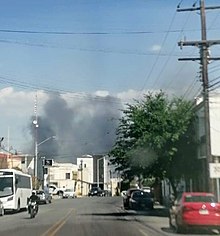
Smoke inhalation is the master cause of death in victims of indoor fires. The smoke kills by a combination of thermal damage, poisoning and pulmonary irritation acquired by carbon monoxide, hydrogen cyanide and other combustion products.
Smoke is an aerosol (or mist) of solid particles and liquid droplets that are close to the ideal range of sizes for Mie scattering of visible light.[iv]
Chemic composition [edit]
The limerick of fume depends on the nature of the called-for fuel and the conditions of combustion. Fires with high availability of oxygen burn at a high temperature and with a small-scale corporeality of fume produced; the particles are by and large composed of ash, or with large temperature differences, of condensed aerosol of water. High temperature also leads to production of nitrogen oxides.[5] Sulfur content yields sulfur dioxide, or in case of incomplete combustion, hydrogen sulfide.[half-dozen] Carbon and hydrogen are almost completely oxidized to carbon dioxide and h2o.[7] Fires burning with lack of oxygen produce a significantly wider palette of compounds, many of them toxic.[7] Partial oxidation of carbon produces carbon monoxide, while nitrogen-containing materials can yield hydrogen cyanide, ammonia, and nitrogen oxides.[eight] Hydrogen gas can be produced instead of water.[8] Contents of halogens such as chlorine (e.g. in polyvinyl chloride or brominated flame retardants) may atomic number 82 to the production of hydrogen chloride, phosgene, dioxin, and chloromethane, bromomethane and other halocarbons.[8] [ix] Hydrogen fluoride can be formed from fluorocarbons, whether fluoropolymers subjected to fire or halocarbon fire suppression agents. Phosphorus and antimony oxides and their reaction products can be formed from some burn retardant additives, increasing smoke toxicity and corrosivity.[nine] Pyrolysis of polychlorinated biphenyls (PCB), due east.k. from burning older transformer oil, and to lower degree besides of other chlorine-containing materials, can produce 2,iii,7,8-tetrachlorodibenzodioxin, a potent carcinogen, and other polychlorinated dibenzodioxins.[9] Pyrolysis of fluoropolymers, e.g. teflon, in presence of oxygen yields carbonyl fluoride (which hydrolyzes readily to HF and COtwo); other compounds may exist formed likewise, eastward.chiliad. carbon tetrafluoride, hexafluoropropylene, and highly toxic perfluoroisobutene (PFIB).[ten]
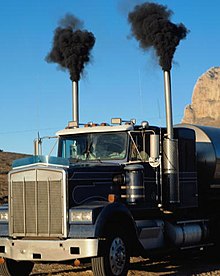
Emission of soot in the fumes of a large diesel truck, without particle filters.
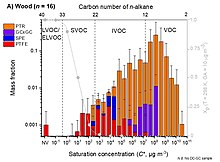
Pyrolysis of called-for fabric, particularly incomplete combustion or smoldering without adequate oxygen supply, also results in production of a large amount of hydrocarbons, both aliphatic (methyl hydride, ethane, ethylene, acetylene) and aromatic (benzene and its derivates, polycyclic aromatic hydrocarbons; eastward.g. benzo[a]pyrene, studied as a carcinogen, or retene), terpenes.[11] It besides results in the emission of a range of smaller oxygenated volatile organic compounds (methanol, acetic acrid, hydroxy acetone, methyl acetate and ethyl formate) which are formed as combustion by products as well as less volatile oxygenated organic species such every bit phenolics, furans and furanones.[1] Heterocyclic compounds may be as well present.[12] Heavier hydrocarbons may condense as tar; smoke with meaning tar content is yellow to brown.[13] Combustion of solid fuels can issue in the emission of many hundreds to thousands of lower volatility organic compounds in the aerosol phase.[14] Presence of such smoke, soot, and/or brown oily deposits during a burn down indicates a possible hazardous situation, as the atmosphere may be saturated with combustible pyrolysis products with concentration higher up the upper flammability limit, and sudden inrush of air can cause flashover or backdraft.[xv]
Presence of sulfur tin lead to germination of gases similar hydrogen sulfide, carbonyl sulfide, sulfur dioxide, carbon disulfide, and thiols; especially thiols tend to get adsorbed on surfaces and produce a lingering odour even long afterwards the burn down. Fractional oxidation of the released hydrocarbons yields in a wide palette of other compounds: aldehydes (due east.grand. formaldehyde, acrolein, and furfural), ketones, alcohols (frequently aromatic, e.thousand. phenol, guaiacol, syringol, catechol, and cresols), carboxylic acids (formic acid, acetic acid, etc.).[ citation needed ]
The visible particulate thing in such smokes is about ordinarily composed of carbon (soot). Other particulates may be composed of drops of condensed tar, or solid particles of ash. The presence of metals in the fuel yields particles of metal oxides. Particles of inorganic salts may also be formed, due east.g. ammonium sulfate, ammonium nitrate, or sodium chloride. Inorganic salts present on the surface of the soot particles may make them hydrophilic. Many organic compounds, typically the aromatic hydrocarbons, may exist besides adsorbed on the surface of the solid particles. Metal oxides tin can exist nowadays when metal-containing fuels are burned, e.k. solid rocket fuels containing aluminium. Depleted uranium projectiles afterward impacting the target ignite, producing particles of uranium oxides. Magnetic particles, spherules of magnetite-like ferrous ferric oxide, are present in coal smoke; their increase in deposits after 1860 marks the beginning of the Industrial Revolution.[16] (Magnetic fe oxide nanoparticles tin can be also produced in the smoke from meteorites burning in the temper.)[17] Magnetic remanence, recorded in the fe oxide particles, indicates the strength of World'due south magnetic field when they were cooled beyond their Curie temperature; this can be used to distinguish magnetic particles of terrestrial and meteoric origin.[eighteen] Fly ash is composed mainly of silica and calcium oxide. Cenospheres are present in smoke from liquid hydrocarbon fuels. Minute metal particles produced by abrasion can exist present in engine smokes. Amorphous silica particles are present in smokes from burning silicones; small proportion of silicon nitride particles can be formed in fires with insufficient oxygen. The silica particles have most x nm size, clumped to lxx–100 nm aggregates and further agglomerated to chains.[x] Radioactive particles may exist present due to traces of uranium, thorium, or other radionuclides in the fuel; hot particles tin be present in example of fires during nuclear accidents (e.m. Chernobyl disaster) or nuclear war.
Smoke particulates, like other aerosols, are categorized into three modes based on particle size:
- nuclei fashion, with geometric mean radius betwixt 2.v–20 nm, likely forming past condensation of carbon moieties.
- accumulation mode, ranging betwixt 75–250 nm and formed by coagulation of nuclei fashion particles
- fibroid mode, with particles in micrometer range
Virtually of the smoke material is primarily in coarse particles. Those undergo rapid dry precipitation, and the smoke impairment in more distant areas outside of the room where the fire occurs is therefore primarily mediated by the smaller particles.[19]
Aerosol of particles beyond visible size is an early indicator of materials in a preignition phase of a fire.[x]
Burning of hydrogen-rich fuel produces water vapor; this results in fume containing droplets of h2o. In absence of other colour sources (nitrogen oxides, particulates...), such smoke is white and cloud-similar.
Smoke emissions may contain characteristic trace elements. Vanadium is present in emissions from oil fired power plants and refineries; oil plants besides emit some nickel. Coal combustion produces emissions containing aluminium, arsenic, chromium, cobalt, copper, atomic number 26, mercury, selenium, and uranium.
Traces of vanadium in high-temperature combustion products form droplets of molten vanadates. These attack the passivation layers on metals and cause high temperature corrosion, which is a concern especially for internal combustion engines. Molten sulfate and atomic number 82 particulates too have such consequence.
Some components of smoke are characteristic of the combustion source. Guaiacol and its derivatives are products of pyrolysis of lignin and are characteristic of wood smoke; other markers are syringol and derivates, and other methoxy phenols. Retene, a product of pyrolysis of conifer trees, is an indicator of forest fires. Levoglucosan is a pyrolysis product of cellulose. Hardwood vs softwood smokes differ in the ratio of guaiacols/syringols. Markers for vehicle frazzle include polycyclic effluvious hydrocarbons, hopanes, steranes, and specific nitroarenes (east.g. 1-nitropyrene). The ratio of hopanes and steranes to elemental carbon tin can be used to distinguish between emissions of gasoline and diesel fuel engines.[20]
Many compounds can be associated with particulates; whether by being adsorbed on their surfaces, or past beingness dissolved in liquid droplets. Hydrogen chloride is well captivated in the soot particles.[19]
Inert particulate matter can be disturbed and entrained into the smoke. Of particular business organization are particles of asbestos.
Deposited hot particles of radioactive fallout and bioaccumulated radioisotopes can be reintroduced into the atmosphere by wildfires and woods fires; this is a business organization in e.g. the Zone of breach containing contaminants from the Chernobyl disaster.
Polymers are a meaning source of smoke. Aromatic side groups, due east.k. in polystyrene, heighten generation of smoke. Effluvious groups integrated in the polymer backbone produce less fume, probable due to meaning charring. Aliphatic polymers tend to generate the least fume, and are not-cocky-extinguishing. Still presence of additives tin significantly increase fume formation. Phosphorus-based and halogen-based flame retardants decrease production of smoke. Higher degree of cross-linking between the polymer chains has such outcome as well.[21]
Visible and invisible particles of combustion [edit]


Smoke ascent up from the smoldering remains of a recently extingished mount burn in South Africa.
The naked eye detects particle sizes greater than vii µm (micrometres). Visible particles emitted from a fire are referred to every bit smoke. Invisible particles are generally referred to as gas or fumes. This is best illustrated when toasting bread in a toaster. As the bread heats upward, the products of combustion increase in size. The fumes initially produced are invisible only become visible if the toast is burnt.
An ionization sleeping accommodation type fume detector is technically a product of combustion detector, non a fume detector. Ionization chamber blazon smoke detectors detect particles of combustion that are invisible to the naked centre. This explains why they may frequently simulated alarm from the fumes emitted from the ruby-hot heating elements of a toaster, before the presence of visible fume, yet they may fail to activate in the early, low-estrus smoldering stage of a burn.
Smoke from a typical house fire contains hundreds of different chemicals and fumes. As a effect, the damage caused by the smoke can often exceed that caused by the actual heat of the fire. In addition to the physical damage caused by the smoke of a burn – which manifests itself in the form of stains – is the ofttimes fifty-fifty harder to eliminate problem of a smoky odor. Merely as in that location are contractors that specialize in rebuilding/repairing homes that have been damaged by fire and fume, textile restoration companies specialize in restoring fabrics that have been damaged in a fire.
Dangers [edit]
Fume from oxygen-deprived fires contains a pregnant concentration of compounds that are combustible. A deject of smoke, in contact with atmospheric oxygen, therefore has the potential of being ignited – either past another open flame in the area, or by its own temperature. This leads to furnishings similar backdraft and flashover. Smoke inhalation is too a danger of smoke that tin can cause serious injury and death.[ citation needed ]
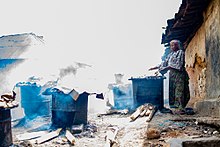
Processing fish while beingness exposed to fume
Many compounds of fume from fires are highly toxic and/or irritating. The most dangerous is carbon monoxide leading to carbon monoxide poisoning, sometimes with the additive effects of hydrogen cyanide and phosgene. Smoke inhalation can therefore quickly lead to incapacitation and loss of consciousness. Sulfur oxides, hydrogen chloride and hydrogen fluoride in contact with moisture form sulfuric, hydrochloric and hydrofluoric acid, which are corrosive to both lungs and materials. When asleep the nose does not sense smoke nor does the brain, just the trunk volition wake up if the lungs get enveloped in smoke and the brain volition be stimulated and the person will be awoken. This does not work if the person is incapacitated or under the influence of drugs and/or alcohol.[ citation needed ]
Cigarette fume is a major modifiable risk factor for lung disease, heart disease, and many cancers. Smoke can also be a component of ambience air pollution due to the called-for of coal in power plants, wood fires or other sources, although the concentration of pollutants in ambient air is typically much less than that in cigarette smoke. One solar day of exposure to PM2.v at a concentration of 880 μg/m3, such as occurs in Beijing, China, is the equivalent of smoking one or two cigarettes in terms of particulate inhalation past weight.[22] [23] The analysis is complicated, notwithstanding, by the fact that the organic compounds present in various ambient particulates may have a college carcinogenicity than the compounds in cigarette fume particulates.[24] Secondhand tobacco smoke is the combination of both sidestream and mainstream fume emissions from a burning tobacco production. These emissions contain more than than l carcinogenic chemicals. According to the United States Surgeon Full general's 2006 report on the discipline, "Brusk exposures to secondhand [tobacco] smoke tin can cause claret platelets to become stickier, impairment the lining of blood vessels, subtract coronary flow velocity reserves, and reduce heart variability, potentially increasing the adventure of a middle assail".[25] The American Cancer Society lists "heart illness, lung infections, increased asthma attacks, middle ear infections, and low birth weight" as ramifications of smoker'southward emission.[26]


Red smoke carried by a parachutist of the UK Lightning Bolts Army Parachute Display Team
Fume tin obscure visibility, impeding occupant exiting from fire areas. In fact, the poor visibility due to the smoke that was in the Worcester Cold Storage Warehouse burn down in Worcester, Massachusetts was the reason why the trapped rescue firefighters could not evacuate the edifice in time. Considering of the striking similarity that each floor shared, the dense fume caused the firefighters to become disoriented.[27]
Corrosion [edit]
Smoke tin contain a wide variety of chemicals, many of them aggressive in nature. Examples are hydrochloric acid and hydrobromic acid, produced from element of group vii-containing plastics and fire retardants, hydrofluoric acid released past pyrolysis of fluorocarbon burn suppression agents, sulfuric acid from burning of sulfur-containing materials, nitric acid from high-temperature fires where nitrous oxide gets formed, phosphoric acrid and antimony compounds from P and Sb based fire retardants, and many others. Such corrosion is non meaning for structural materials, but delicate structures, especially microelectronics, are strongly affected. Corrosion of circuit board traces, penetration of aggressive chemicals through the casings of parts, and other effects can cause an immediate or gradual deterioration of parameters or fifty-fifty premature (and ofttimes delayed, as the corrosion can progress over long time) failure of equipment subjected to smoke. Many smoke components are as well electrically conductive; deposition of a conductive layer on the circuits can cause crosstalks and other deteriorations of the operating parameters or even crusade brusque circuits and total failures. Electrical contacts can be affected past corrosion of surfaces, and past deposition of soot and other conductive particles or nonconductive layers on or across the contacts. Deposited particles may adversely affect the operation of optoelectronics past absorbing or scattering the lite beams.[ citation needed ]
Corrosivity of smoke produced past materials is characterized by the corrosion index (CI), defined every bit material loss rate (angstrom/minute) per corporeality of fabric gasified products (grams) per book of air (m3). Information technology is measured by exposing strips of metal to period of combustion products in a test tunnel. Polymers containing element of group vii and hydrogen (polyvinyl chloride, polyolefins with halogenated additives, etc.) accept the highest CI as the corrosive acids are formed straight with water produced by the combustion, polymers containing halogen but (e.thou. polytetrafluoroethylene) have lower CI as the formation of acrid is limited to reactions with airborne humidity, and halogen-free materials (polyolefins, wood) have the lowest CI.[nineteen] Nevertheless, some halogen-costless materials can likewise release significant amount of corrosive products.[28]
Fume damage to electronic equipment can be significantly more extensive than the burn itself. Cablevision fires are of special business organisation; depression smoke cypher element of group vii materials are preferable for cablevision insulation.[ citation needed ]
When smoke comes into contact with the surface of whatsoever substance or construction, the chemicals contained in information technology are transferred to it. The corrosive properties of the chemicals cause the substance or construction to decompose at a rapid rate. Certain materials or structures blot these chemicals, which is why wearable, unsealed surfaces, potable water, piping, wood, etc., are replaced in almost cases of structural fires.[ citation needed ]
Health furnishings of wood smoke [edit]
Forest smoke is a major source of air pollution,[29] [xxx] [31] [32] especially particulate pollution,[30] polycyclic effluvious hydrocarbons (PAHs) and volatile organic compounds (VOCs)[thirty] such as formaldehyde.[33] In the United Kingdom domestic combustion is the largest single source of PM2.5 annually.[34] In some towns and cities in New South Wales, forest smoke may be responsible for 60% of fine particle air pollution in the winter.[35] Woods smoke can cause lung damage,[36] [37] artery harm and Deoxyribonucleic acid impairment[38] leading to cancer,[39] [40] other respiratory and lung affliction and cardiovascular disease.[35] [41] Air pollution, particulate affair and woods smoke may also cause brain damage[42] [43] [44] [45] and increase the run a risk of developmental disorders,[46] [47] [48] [49] neurodegenerative disorders[l] [51] mental disorders,[52] [53] [54] and suicide,[52] [54] although studies on the link between depression and some air pollutants are not consequent.[55] At least ane study has identified "the abundant presence in the human encephalon of magnetite nanoparticles that friction match precisely the high-temperature magnetite nanospheres, formed by combustion and/or friction-derived heating, which are prolific in urban, airborne particulate matter (PM)."[56] Air pollution has also been linked to a range of other psychosocial problems.[53]
Measurement [edit]
Equally early equally the 15th century Leonardo da Vinci commented at length on the difficulty of assessing smoke, and distinguished between blackness smoke (carbonized particles) and white 'smoke' which is non a fume at all simply merely a interruption of harmless water particulates.[57]
Smoke from heating appliances is unremarkably measured in one of the following ways:
In-line capture. A fume sample is but sucked through a filter which is weighed before and after the test and the mass of smoke found. This is the simplest and probably the well-nigh accurate method, but tin can only be used where the smoke concentration is slight, as the filter tin can quickly become blocked.[58]
The ASTM smoke pump is a simple and widely used method of in-line capture where a measured volume of smoke is pulled through a filter paper and the dark spot so formed is compared with a standard.
Filter/dilution tunnel. A fume sample is drawn through a tube where it is diluted with air, the resulting smoke/air mixture is and then pulled through a filter and weighed. This is the internationally recognized method of measuring fume from combustion.[59]
Electrostatic precipitation. The fume is passed through an assortment of metal tubes which contain suspended wires. A (huge) electrical potential is applied across the tubes and wires then that the smoke particles get charged and are attracted to the sides of the tubes. This method can over-read by capturing harmless condensates, or under-read due to the insulating effect of the fume. However, it is the necessary method for assessing volumes of smoke too great to be forced through a filter, i.e., from bituminous coal.
Ringelmann calibration. A mensurate of smoke color. Invented by Professor Maximilian Ringelmann in Paris in 1888, information technology is essentially a carte du jour with squares of black, white and shades of gray which is held upwards and the comparative grayness of the smoke judged. Highly dependent on calorie-free weather and the skill of the observer it allocates a grayness number from 0 (white) to five (black) which has but a passing relationship to the actual quantity of fume. Nonetheless, the simplicity of the Ringelmann scale means that it has been adopted as a standard in many countries.
Optical scattering. A low-cal beam is passed through the smoke. A light detector is situated at an bending to the light source, typically at 90°, then that information technology receives simply low-cal reflected from passing particles. A measurement is made of the light received which will be higher as the concentration of smoke particles becomes higher.
Optical obscuration. A low-cal axle is passed through the fume and a detector opposite measures the calorie-free. The more than smoke particles are present between the two, the less light volition be measured.
Combined optical methods. In that location are various proprietary optical smoke measurement devices such every bit the 'nephelometer' or the 'aethalometer' which use several unlike optical methods, including more than than i wavelength of light, within a single musical instrument and apply an algorithm to give a good guess of smoke. Information technology has been claimed that these devices tin can differentiate types of smoke so their probable source can exist inferred, though this is disputed.[60]
Inference from carbon monoxide. Smoke is incompletely burned fuel, carbon monoxide is incompletely burned carbon, therefore it has long been assumed that measurement of CO in flue gas (a cheap, unproblematic and very accurate procedure) volition provide a good indication of the levels of smoke. Indeed, several jurisdictions apply CO measurement as the footing of smoke control. However it is far from clear how authentic the correspondence is.
Medicinal smoking [edit]
Throughout recorded history, humans accept used the smoke of medicinal plants to cure affliction. A sculpture from Persepolis shows Darius the Slap-up (522–486 BC), the king of Persia, with ii censers in front of him for burning Peganum harmala and/or sandalwood Santalum album, which was believed to protect the king from evil and disease. More than 300 plant species in five continents are used in smoke form for unlike diseases. Equally a method of drug assistants, smoking is of import as it is a unproblematic, inexpensive, but very effective method of extracting particles containing active agents. More importantly, generating smoke reduces the particle size to a microscopic scale thereby increasing the absorption of its active chemic principles.[61]
References [edit]
- ^ a b Stewart, Gareth J.; Acton, W. Joe F.; Nelson, Beth S.; Vaughan, Adam R.; Hopkins, James R.; Arya, Rahul; Mondal, Arnab; Jangirh, Ritu; Ahlawat, Sakshi; Yadav, Lokesh; Sharma, Sudhir G.; Dunmore, Rachel Due east.; Yunus, Siti Southward. Thou.; Hewitt, C. Nicholas; Nemitz, Eiko; Mullinger, Neil; Gadi, Ranu; Sahu, Lokesh K.; Tripathi, Nidhi; Rickard, Andrew R.; Lee, James D.; Mandal, Tuhin Thou.; Hamilton, Jacqueline F. (18 February 2021). "Emissions of non-methane volatile organic compounds from combustion of domestic fuels in Delhi, India". Atmospheric Chemistry and Physics. 21 (four): 2383–2406. Bibcode:2021ACP....21.2383S. doi:x.5194/acp-21-2383-2021.
- ^ Stewart, Gareth J.; Nelson, Beth S.; Acton, Due west. Joe F.; Vaughan, Adam R.; Hopkins, James R.; Yunus, Siti S. M.; Hewitt, C. Nicholas; Nemitz, Eiko; Mandal, Tuhin K.; Gadi, Ranu; Sahu, Lokesh. Thousand.; Rickard, Andrew R.; Lee, James D.; Hamilton, Jacqueline F. (2021). "Comprehensive organic emission profiles, secondary organic droplets production potential, and OH reactivity of domestic fuel combustion in Delhi, Republic of india". Environmental Science: Atmospheres. one (2): 104–117. doi:10.1039/D0EA00009D.
- ^ Smoke Production and Properties Archived 21 August 2008 at the Wayback Machine – SFPE Handbook of Fire Protection Technology
- ^ The Virginia Journal of Science. Virginia Academy of Science. 1976. [ folio needed ]
- ^ Lee, C.C. (one January 2005). Ecology Engineering Dictionary. Government Institutes. p. 528. ISBN9780865878488.
- ^ Carlone, Nancy (2009). Nancy Caroline'south Emergency Care in the Streets, Canadian Edition. Burlington, Massachusetts: Jones & Bartlett Learning. pp. twenty–28. ISBN9781284053845.
- ^ a b Mauseth, James D. (1991). Botany: An Introduction to Plant Biology. Burlington, Massachusetts: Jones & Bartlett Learning. p. 234. ISBN9780030938931.
- ^ a b c Reuter, M.A.; Boin, U.M.J.; Schaik, A. van; Verhoef, Eastward.; Heiskanen, K.; Yang, Yongxiang; Georgalli, G. (2 November 2005). The Metrics of Cloth and Metal Ecology. Amsterdam: Elsevier. ISBN9780080457925.
- ^ a b c Fardell, P.J. (one January 1993). Toxicity of Plastics and Rubber in Burn down. iSmithers Rapra Publishing. ISBN978-i-85957-001-2.
- ^ a b c National Inquiry Quango (U.S.). Job Strength on Flammability, Smoke, Toxicity and Corrosive Gases of Electric Cable Materials (1978). Flammability, smoke, toxicity, and corrosive gases of electric cable materials: report of the Job Forcefulness on Flammability, Smoke, Toxicity, and Corrosive Gases of Electric Cable Materials, National Materials Informational Lath, Commission on Sociotechnical Systems, National Research Quango. National Academies. pp. 107–. NAP:15488.
{{cite book}}: CS1 maint: multiple names: authors list (link) - ^ Moldoveanu, S.C. (11 November 1998). Belittling Pyrolysis of Natural Organic Polymers. Elsevier. pp. 152, 428. ISBN9780444822031.
- ^ Moldoveanu, Serban (sixteen September 2009). Pyrolysis of Organic Molecules: Applications to Wellness and Environmental Bug. Elsevier. p. 643. ISBN978-0444531131.
- ^ Staff writer (1892). A dictionary of the coal tar colours. Heywood and Co. p. viii. ISBN978-1409701699.
- ^ Stewart, Gareth J.; Nelson, Beth South.; Acton, W. Joe F.; Vaughan, Adam R.; Farren, Naomi J.; Hopkins, James R.; Ward, Martyn W.; Swift, Stefan J.; Arya, Rahul; Mondal, Arnab; Jangirh, Ritu; Ahlawat, Sakshi; Yadav, Lokesh; Sharma, Sudhir K.; Yunus, Siti S. One thousand.; Hewitt, C. Nicholas; Nemitz, Eiko; Mullinger, Neil; Gadi, Ranu; Sahu, Lokesh K.; Tripathi, Nidhi; Rickard, Andrew R.; Lee, James D.; Mandal, Tuhin Grand.; Hamilton, Jacqueline F. (18 February 2021). "Emissions of intermediate-volatility and semi-volatile organic compounds from domestic fuels used in Delhi, India". Atmospheric Chemistry and Physics. 21 (four): 2407–2426. Bibcode:2021ACP....21.2407S. doi:10.5194/acp-21-2407-2021.
- ^ Fire, Frank Fifty. (2009). The Common Sense Arroyo to Chancy Materials. Fire Engineering Books. p. 129. ISBN978-0912212111.
- ^ Oldfield, F.; Tolonen, One thousand. & Thompson, R. (1981). "History of Particulate Atmospheric Pollution from Magnetic Measurements in Dated Finnish Peat Profiles". Ambio. 10 (4): 185. JSTOR 4312673.
- ^ Lanci, L.; Kent, D. V. (2006). "Meteoric fume fallout revealed by superparamagnetism in Greenland ice". Geophysical Research Letters. 33 (13): L13308. Bibcode:2006GeoRL..3313308L. doi:x.1029/2006GL026480.
- ^ Suavet, C.; Gattacceca, J.; Rochette, P.; Perchiazzi, North.; Folco, L.; Duprat, J.; Harvey, R. P. (4 Apr 2009). "Magnetic properties of micrometeorites" (PDF). Periodical of Geophysical Research. 114 (B4): B04102. Bibcode:2009JGRB..114.4102S. doi:10.1029/2008JB005831.
- ^ a b c Marker, James E. (2006). Physical properties of polymers handbook. Springer. ISBN978-0-387-31235-4.
- ^ "Organic Speciation International Workshop Synthesis_topic7". Wrapair.org. Retrieved 19 February 2010.
- ^ Krevelen, D.W. van; Nijenhuis, Klaas te (2009). Properties of Polymers: Their Correlation with Chemical Structure; Their Numerical Estimation and Prediction from Additive Grouping Contributions. Elsevier. p. 864. ISBN978-0-08-054819-7.
- ^ Pope, C. Arden; Burnett, Richard T.; Turner, Michelle C.; Cohen, Aaron; Krewski, Daniel; Jerrett, Michael; Gapstur, Susan 1000.; Thun, Michael J. (November 2011). "Lung Cancer and Cardiovascular Disease Mortality Associated with Ambient Air Pollution and Cigarette Fume: Shape of the Exposure–Response Relationships". Environmental Health Perspectives. 119 (11): 1616–1621. doi:ten.1289/ehp.1103639. PMC3226505. PMID 21768054.
- ^ St Cyr, MD, Richard (16 January 2013). "Is PM2.5 From Air Pollution The Same As From Smoking?". My Health Beijing . Retrieved xvi September 2015.
- ^ Cupitt, L T; Glen, W G; Lewtas, J (October 1994). "Exposure and risk from ambient particle-jump pollution in an airshed dominated by residential wood combustion and mobile sources". Ecology Health Perspectives. 102 (suppl 4): 75–84. doi:10.1289/ehp.94102s475. PMC1566933. PMID 7529707.
- ^ Full general, Surgeon. "The Health Consequences of Involuntary Exposure to Tobacco Smoke: A Report of the Surgeon General" (PDF). U.S. Department of Health and Human Services, Centers for Disease Control and Prevention, National Center for Chronic Disease Prevention and Health Promotion, Role on Smoking and Health. Retrieved 27 February 2017.
- ^ "Secondhand Smoke". American Cancer Lodge. Retrieved eleven January 2011.
- ^ "telegram.com – Warehouse Tragedy".
- ^ Ronald C. Lasky, Ronald Lasky, Ulf 50. Österberg, Daniel P. Stigliani (1995). Optoelectronics for data communication. Academic Printing. p. 43. ISBN978-0-12-437160-six.
{{cite volume}}: CS1 maint: uses authors parameter (link) - ^ EPA, NSW. "reducing-wood-smoke-emissions". NSW Environment Protection Authority.
- ^ a b c "Section of Agriculture, Water and the Surround". Section of Agriculture, Water and the Environment.
- ^ "Woods fume major source of pollution in winter" (PDF). ec.europa.eu. 2007. Retrieved 2 May 2021.
- ^ "Air pollution and health" (PDF). healthywa.wa.gov.au . Retrieved ii May 2021.
- ^ US EPA, OAR (28 May 2013). "Wood Smoke and Your Wellness". US EPA.
- ^ Hawkes, N. (22 May 2015). "Air pollution in UK: the public health trouble that won't go away". BMJ. 350 (may22 ane): h2757. doi:x.1136/bmj.h2757. PMID 26001592. S2CID 40717317.
- ^ a b "Wood burning heaters and your wellness - Fact sheets". www.health.nsw.gov.au.
- ^ "Wood smoke and your health". Minnesota Pollution Control Agency. 16 Nov 2009.
- ^ "Wood stove pollution is a burning upshot". www.iatp.org.
- ^ Danielsen, Pernille Høgh; Møller, Peter; Jensen, Keld Alstrup; Sharma, Anoop Kumar; Wallin, Håkan; Bossi, Rossana; Autrup, Herman; Mølhave, Lars; Ravanat, Jean-Luc; Briedé, Jacob Jan; de Kok, Theo Martinus; Loft, Steffen (18 Feb 2011). "Oxidative Stress, DNA Damage, and Inflammation Induced by Ambience Air and Woods Smoke Particulate Matter in Human A549 and THP-one Prison cell Lines". Chemical Research in Toxicology. 24 (2): 168–184. doi:ten.1021/tx100407m. PMID 21235221.
- ^ Navarro, Kathleen Thou.; Kleinman, Michael T.; Mackay, Chris E.; Reinhardt, Timothy E.; Balmes, John R.; Broyles, George A.; Ottmar, Roger D.; Naher, Luke P.; Domitrovich, Joseph W. (June 2019). "Wildland firefighter smoke exposure and take a chance of lung cancer and cardiovascular illness mortality". Environmental Research. 173: 462–468. Bibcode:2019ER....173..462N. doi:10.1016/j.envres.2019.03.060. PMID 30981117. S2CID 108987257.
- ^ "Don't underestimate the health dangers of wood smoke".
- ^ Bede-Ojimadu, Onyinyechi; Orisakwe, Orish Ebere (20 March 2020). "Exposure to Wood Smoke and Associated Health Effects in Sub-Saharan Africa: A Systematic Review". Annals of Global Health. 86 (i): 32. doi:ten.5334/aogh.2725. PMC7082829. PMID 32211302.
- ^ Peeples, Lynne (23 June 2020). "News Characteristic: How air pollution threatens brain health". Proceedings of the National Academy of Sciences. 117 (25): 13856–13860. Bibcode:2020PNAS..11713856P. doi:10.1073/pnas.2008940117. PMC7322062. PMID 32493753.
- ^ "Air pollution particles in young brains linked to Alzheimer's impairment". the Guardian. 6 October 2020.
- ^ "Air Pollution May Harm People's Brains". The Scientist Magazine®.
- ^ "Stanford written report shows wood fume can harm the encephalon". ABC7 San Francisco. 2 Dec 2017.
- ^ Flores-Pajot, Marie-Claire; Ofner, Marianna; Do, Minh T.; Lavigne, Eric; Villeneuve, Paul J. (Nov 2016). "Babyhood autism spectrum disorders and exposure to nitrogen dioxide, and particulate matter air pollution: A review and meta-analysis". Ecology Research. 151: 763–776. Bibcode:2016ER....151..763F. doi:ten.1016/j.envres.2016.07.030. PMID 27609410.
- ^ Chun, HeeKyoung; Leung, Cheryl; Wen, Shi Wu; McDonald, Judy; Shin, Hwashin H. (January 2020). "Maternal exposure to air pollution and risk of autism in children: A systematic review and meta-analysis". Environmental Pollution. 256: 113307. doi:10.1016/j.envpol.2019.113307. PMID 31733973.
- ^ Lam, Juleen; Sutton, Patrice; Kalkbrenner, Amy; Windham, Gayle; Halladay, Alycia; Koustas, Erica; Lawler, Cindy; Davidson, Lisette; Daniels, Natalyn; Newschaffer, Craig; Woodruff, Tracey (21 September 2016). "A Systematic Review and Meta-Assay of Multiple Airborne Pollutants and Autism Spectrum Disorder". PLOS One. 11 (9): e0161851. Bibcode:2016PLoSO..1161851L. doi:10.1371/journal.pone.0161851. PMC5031428. PMID 27653281.
- ^ Weisskopf, Marc Grand.; Kioumourtzoglou, Marianthi-Anna; Roberts, Andrea Fifty. (December 2015). "Air Pollution and Autism Spectrum Disorders: Causal or Confounded?". Current Environmental Health Reports. 2 (4): 430–439. doi:x.1007/s40572-015-0073-9. PMC4737505. PMID 26399256.
- ^ Fu, Pengfei; Yung, Ken Kin Lam (15 September 2020). "Air Pollution and Alzheimer's Illness: A Systematic Review and Meta-Analysis". Periodical of Alzheimer's Disease. 77 (2): 701–714. doi:10.3233/JAD-200483. PMID 32741830. S2CID 220942039.
- ^ Tsai, Tsung-Lin; Lin, Yu-Ting; Hwang, Bing-Fang; Nakayama, Shoji F.; Tsai, Chon-Haw; Sun, Xian-Liang; Ma, Chaochen; Jung, Chau-Ren (October 2019). "Fine particulate thing is a potential determinant of Alzheimer's disease: A systemic review and meta-analysis". Environmental Research. 177: 108638. Bibcode:2019ER....177j8638T. doi:10.1016/j.envres.2019.108638. PMID 31421449. S2CID 201057595.
- ^ a b Braithwaite, Isobel; Zhang, Shuo; Kirkbride, James B.; Osborn, David P. J.; Hayes, Joseph F. (December 2019). "Air Pollution (Particulate Thing) Exposure and Associations with Depression, Anxiety, Bipolar, Psychosis and Suicide Take chances: A Systematic Review and Meta-Analysis". Environmental Wellness Perspectives. 127 (12): 126002. doi:10.1289/EHP4595. PMC6957283. PMID 31850801.
- ^ a b Lu, Jackson G (Apr 2020). "Air pollution: A systematic review of its psychological, economic, and social effects". Electric current Opinion in Psychology. 32: 52–65. doi:x.1016/j.copsyc.2019.06.024. PMID 31557706. S2CID 199147061.
- ^ a b Liu, Qisijing; Wang, Wanzhou; Gu, Xuelin; Deng, Furong; Wang, Xueqin; Lin, Hualiang; Guo, Xinbiao; Wu, Shaowei (February 2021). "Association between particulate affair air pollution and risk of depression and suicide: a systematic review and meta-analysis". Ecology Science and Pollution Research. 28 (eight): 9029–9049. doi:x.1007/s11356-021-12357-3. PMID 33481201. S2CID 231677095.
- ^ Fan, Shu-Jun; Heinrich, Joachim; Blossom, Michael S.; Zhao, Tian-Yu; Shi, Tong-Xing; Feng, Wen-Ru; Dominicus, Yi; Shen, Ji-Chuan; Yang, Zhi-Cong; Yang, Bo-Yi; Dong, Guang-Hui (January 2020). "Ambience air pollution and depression: A systematic review with meta-assay up to 2019". Science of the Full Environment. 701: 134721. Bibcode:2020ScTEn.701m4721F. doi:10.1016/j.scitotenv.2019.134721. PMID 31715478. S2CID 207944384.
- ^ Maher, Barbara A.; Ahmed, Imad A. M.; Karloukovski, Vassil; MacLaren, Donald A.; Foulds, Penelope Grand.; Allsop, David; Mann, David M. A.; Torres-Jardón, Ricardo; Calderon-Garciduenas, Lilian (27 September 2016). "Magnetite pollution nanoparticles in the human brain". Proceedings of the National University of Sciences. 113 (39): 10797–10801. Bibcode:2016PNAS..11310797M. doi:10.1073/pnas.1605941113. PMC5047173. PMID 27601646.
- ^ Sorensen, Roy (2016). A Cabinet of Philosophical Curiosities: A Collection of Puzzles, Oddities, Riddles, and Dilemmas. Oxford Academy Press. p. 89. ISBN978-0190468637.
- ^ Watson, Donna S. (8 March 2010). Perioperative Safety. Amsterdam, Netherlands: Elsevier Health Sciences. ISBN978-0-323-06985-four.
- ^ National Academies (one January 1983). Polycyclic Aromatic Hydrocarbons: Evaluation of Sources and Furnishings (Study). National Academies. p. iv.
- ^ Harrison & others, Roy M (26 August 2013). "An evaluation of some issues regarding the use of aethalometers to mensurate woodsmoke concentrations" (PDF). Atmospheric Environment. 80: 540–548. Bibcode:2013AtmEn..80..540H. doi:10.1016/j.atmosenv.2013.08.026.
- ^ Mohagheghzadeh, Abdolali; Faridi, Pouya; Shams-Ardakani, Mohammadreza; Ghasemi, Younes (2006). "Medicinal smokes". Periodical of Ethnopharmacology. 108 (ii): 161–84. doi:10.1016/j.jep.2006.09.005. PMID 17030480.
Sources [edit]
- . Encyclopædia Britannica. Vol. 25 (11th ed.). 1911.
External links [edit]
 | Wikimedia Commons has media related to Smoke. |
- Burning Bug wood smoke Site
- Shedding new lite on woods fume

What Is The Chemical Makeup Of Smoke,
Source: https://en.wikipedia.org/wiki/Smoke
Posted by: williswiturs.blogspot.com
0 Response to "What Is The Chemical Makeup Of Smoke"
Post a Comment