

What Is The Pigment Makeup Of Pthalo Blue Watercolor
Phthalo pigments are a family of blue and dark-green synthetic organic pigments based on variants of copper phthalocyanine, a deep blue compound produced by the reaction of phthalic anhydride, urea, copper and ammonia. It was first sold equally a pigment in 1935 nether the trade proper noun Monastral Blue (some paint manufacturers yet employ this name). When it was discovered, it was thought to be the about pregnant advance in creative person pigments since the discovery of synthetic Ultramarine Blue in 1826.
Phthalo pigments are transparent, highly staining, and reliably lightfast. They are ordinarily used in industrial and printing applications, besides as in creative person paints. Phthalocyanine dye is even used as a toothpaste colourant.
The spectrum of Phthalo pigments ranges from deep, warm blues to cool spring greens. There are blood-red and green shades of Phthalo Bluish available in many creative person paint ranges, as well as two different Phthalo greenish pigments. In this commodity, I explore the differences between them, and the unique qualities they bring to an creative person palette.
Phthalo Blueish, Green Shade (PB15, PB15:iii)
With its distinctive light-green undertones and cool temperature, Phthalo Blueish Dark-green Shade is considered the 'default' Phthalo Blue. Some paint ranges have only ane Phthalo Blue, and if a crimson or a greenish shade is not specified the paint is about likely to be a green shade of Phthalo Blue. When using a split primary palette, a green shade of Phthalo Blueish is a skillful choice for a cool blue.
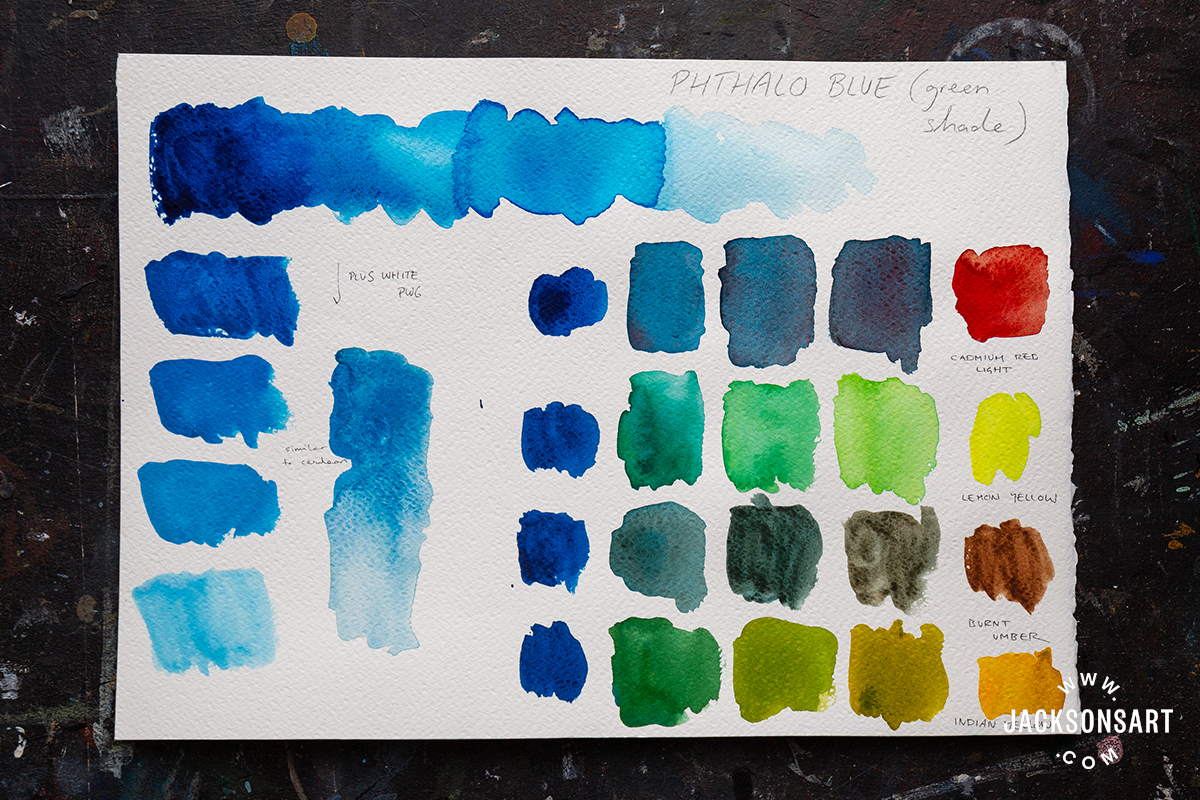
Left: Phthalo Blueish Green Shade in tints with Titanium White.
Right: Phthalo Blueish Green Shade in mixtures with Cadmium Cherry Light, Lemon Yellowish, Burnt Umber, and Indian Xanthous Hue
With an opaque and highly tinting scarlet like Cadmium Ruddy Calorie-free, it makes a stiff, semi-transparent well-nigh-black. Mixed with lemon yellowish (another cool pigment), it produces precipitous and vibrant greens. In tints with white, Phthalo Blue Green Shade makes a sky-blue colour similar to Cerulean Blue. This could be useful for watercolourists who prefer not-granulating pigments, but who like the softness of Cerulean. It is also capable of mixing some natural greens when mixed with an world colour or a warm yellow, as seen to a higher place with Burnt Umber and Indian Yellowish.
Phthalo Bluish, Carmine Shade (PB15, PB15:1)
Phthalo Blue Red Shade is a warmer variant of Phthalo Blue Light-green Shade. It is similar in masstone (its appearance nifty from the tube) to Prussian Blue just has the clean brightness of Ultramarine Blueish when thinned. Information technology is a useful colour for artists who want to reach dark, warm values in their paintings. The following is a comparison between Phthalo Blue Red Shade and Phthalo Blue Greenish Shade when mixed with the same colours:
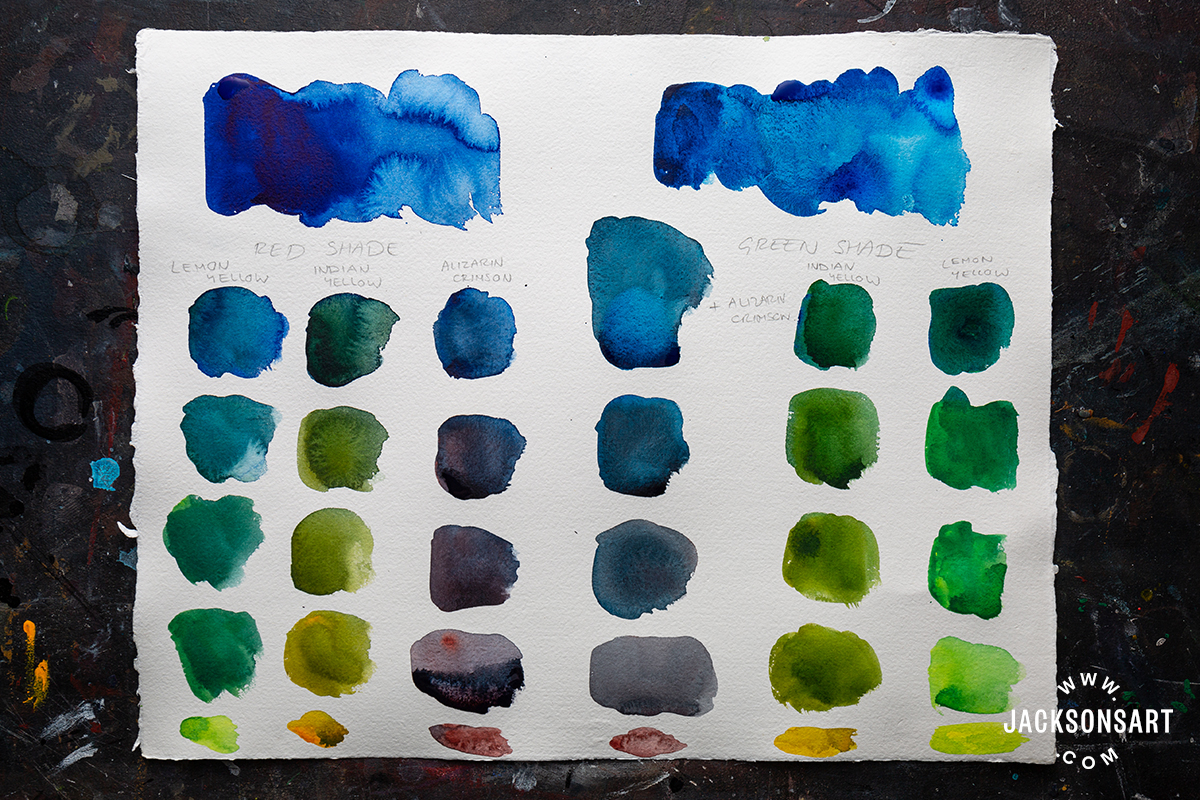
Left: Phthalo Blue Scarlet Shade with Lemon Yellow (left column), Indian Yellow Hue (centre column), and Alizarin Crimson (right cavalcade), with increasing amounts of the other colour added to Phthalo bluish equally you move down the nautical chart.
Right: Phthalo Blue Light-green Shade with Alizarin Crimson (left cavalcade), Indian Yellow Hue (middle column), and Lemon Yellow (right column), with increasing amounts of the other colour added to Phthalo blue as yous move downwardly the chart.
The colour mixtures are quite like, only the deviation in colour temperature could make all of the divergence in a palette. Natural greens are easier to reach with the redder shade of Phthalo Bluish, while Phthalo Blueish Green Shade created more acidic, synthetic looking greens (those these could exist neutralised with the addition of a red pigment). When choosing between a green shade or a red shade of Phthalo Blueish, it is recommended to consider the overall temperature of the painting. The Phthalo Blue Light-green Shade volition contribute to a general cool mood of a painting, while the cherry-red shade tin impart more warmth.
Phthalo Green (PG7)

Phthalo Light-green paint absorbs more blue light than Phthalo Blue, and this is accomplished by chlorinating copper phthalocyanine paint. It is a velvety colour with very deep, blue undertones.

Left: Phthalo Dark-green Shade in tints with Titanium White.
Correct: Phthalo Blue Green Shade in mixtures with Burnt Sienna, Lemon Yellow, Indian Yellowish Hue, and Alizarin Crimson
Its depth of colour, equally well as its luminous transparency, means that Phthalo Green lends itself well to seascapes. When mixed with white, it makes a range of turquoises. While many mural artists choose to mix their own greens rather than using it from the tube, Phthalo Light-green tin still make a useful add-on to a landscape palette. By adjusting it with Burnt Sienna or another earth color, its blue undertones are neutralised and information technology produced some deep browns. Mixing Phthalo Dark-green with Alizarin Crimson makes a chromatic shadowy blackness.
Phthalo Green, Xanthous Shade (PG36)
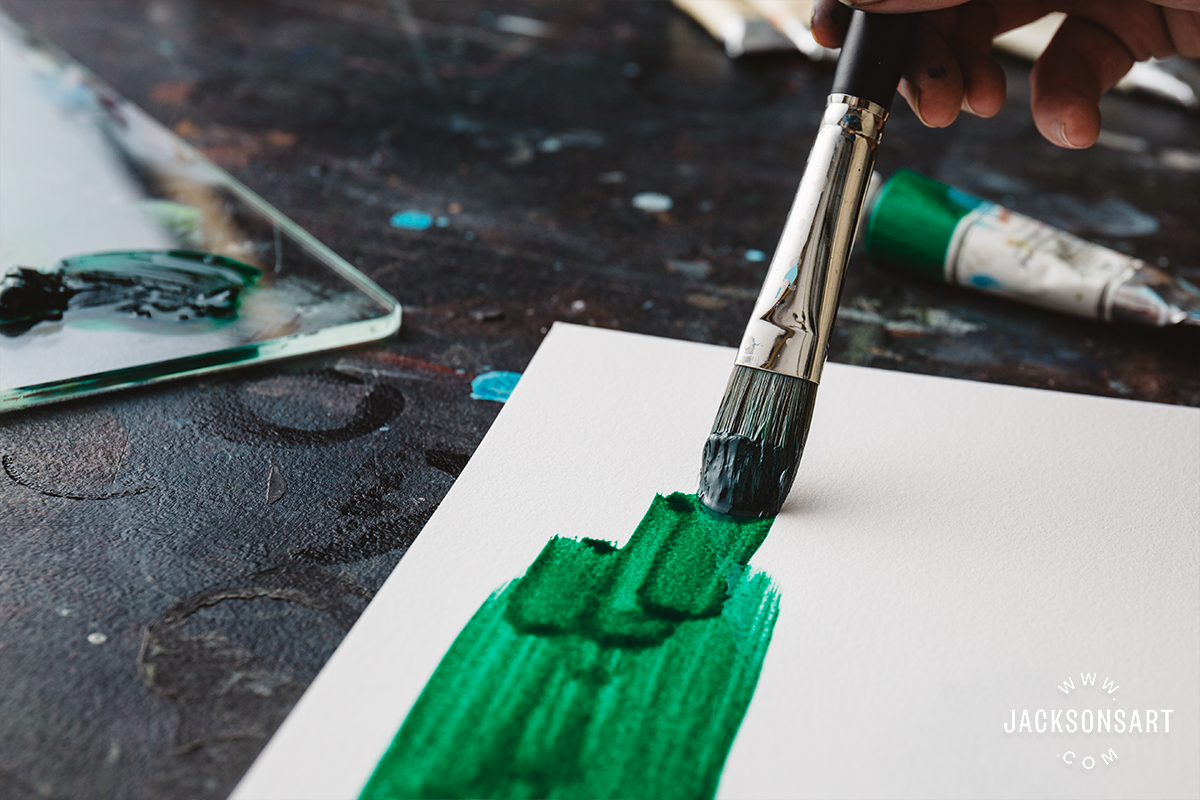
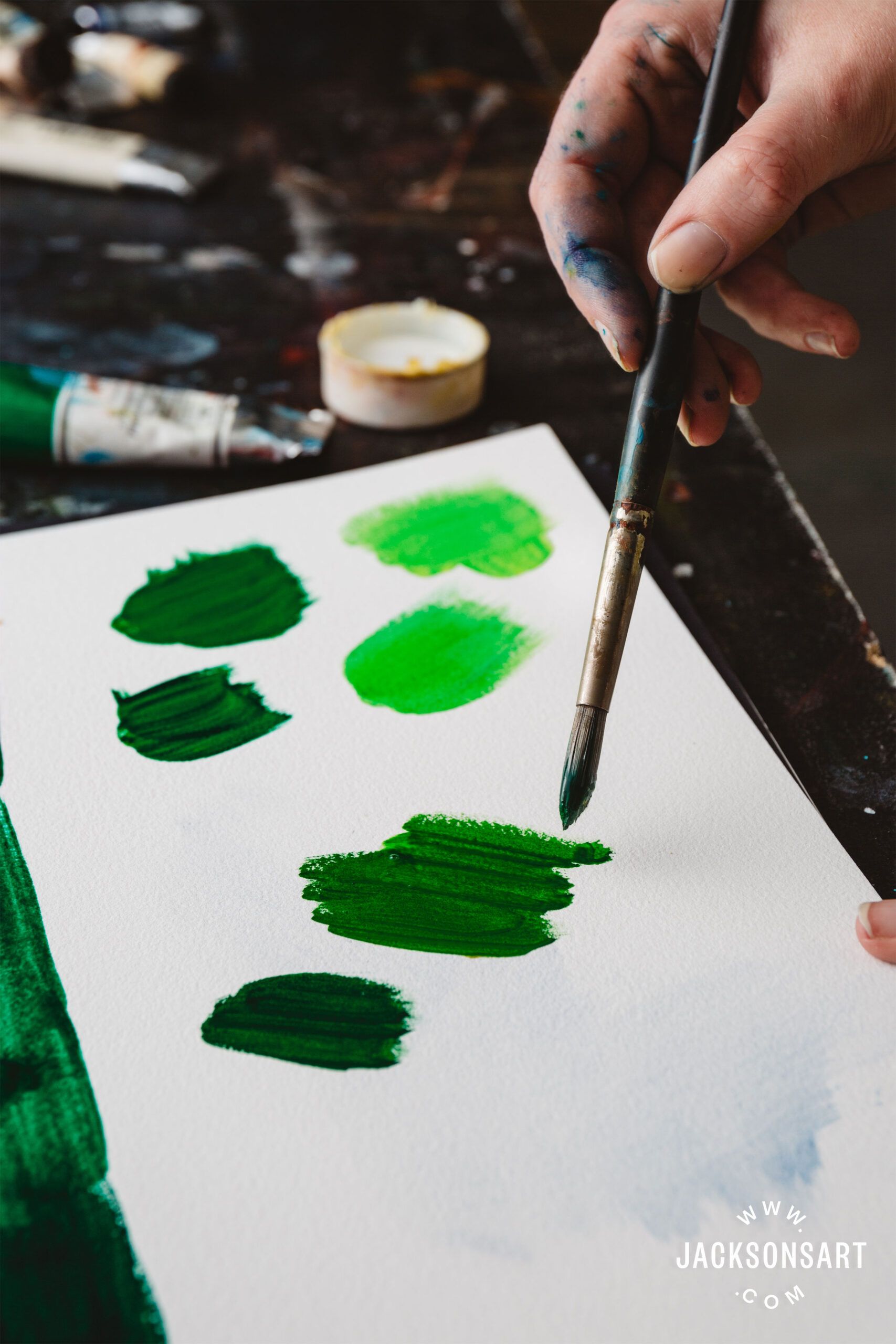
Usually a picayune more expensive than the other Phthalo pigments, Phthalo Green Yellow Shade is made by treating copper phthalocyanine with bromine. It is a very make clean, emerald green with more yellow undertones. Like Phthalo Light-green, it makes an interesting addition to a landscape palette when mixed with an earth colour and makes some deep blacks when mixed with cerise. One of its most exciting mixing compliments is lemon yellow, which makes almost fluorescent greens (seen below).
We would dear to know how you use Phthalo pigments. Some artists find their extraordinarily high tinting forcefulness unhelpful (one artist I spoke to called them 'inconsiderate' pigments considering they overwhelm other colours), while others love that they are capable of both incredible depths of colour and delicate transparent glazes when thinned. Let us know by leaving a comment beneath.
Product ranges referenced in this commodity:
- Jackson's Creative person Watercolours
- Daniel Smith Watercolours
- Michael Harding Oil Paints
More than articles near pigments and color mixing:
- The Enduring Entreatment of Alizarin Crimson
- The Story of Ultramarine Bluish and French Ultramarine
- Comparing Black Pigments, and Getting the Most out of Using Blackness in your Palette

Source: https://www.jacksonsart.com/blog/2021/02/09/the-unique-qualities-of-phthalo-pigments/
Posted by: williswiturs.blogspot.com
0 Response to "What Is The Pigment Makeup Of Pthalo Blue Watercolor"
Post a Comment